
Appearance
Output Routing
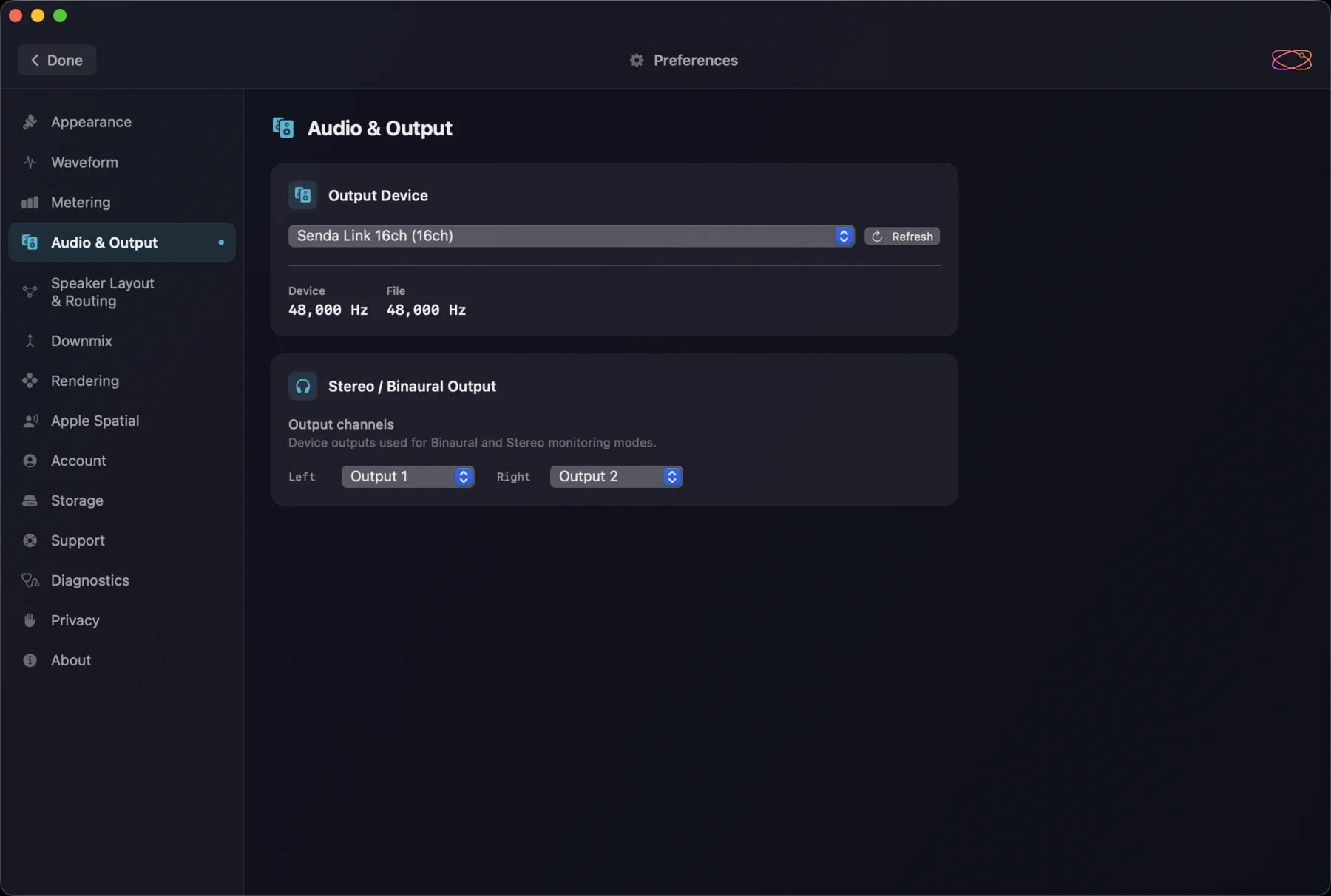
Orbit Lite lets you choose your output device and route channels to it. Device selection lives in Preferences ▸ Audio & Output; speaker layouts and the routing matrix live in Preferences ▸ Speaker Layout & Routing.
On iPhone and iPad
The same panes are under Settings (tap Settings or Routing in the footer). Tap a matrix cell to route it, and long-press to ripple a diagonal. With no class-compliant interface connected, 7.1.4 plays through the device's built-in Spatial Audio. See Orbit Lite on iPhone & iPad.
Output device
Pick your interface or output in the Output Device menu, and use Refresh to pick up a newly-connected device. The pane also shows the Device and File sample rates side by side, so you can spot a mismatch at a glance (see Sample rate below).
The routing matrix
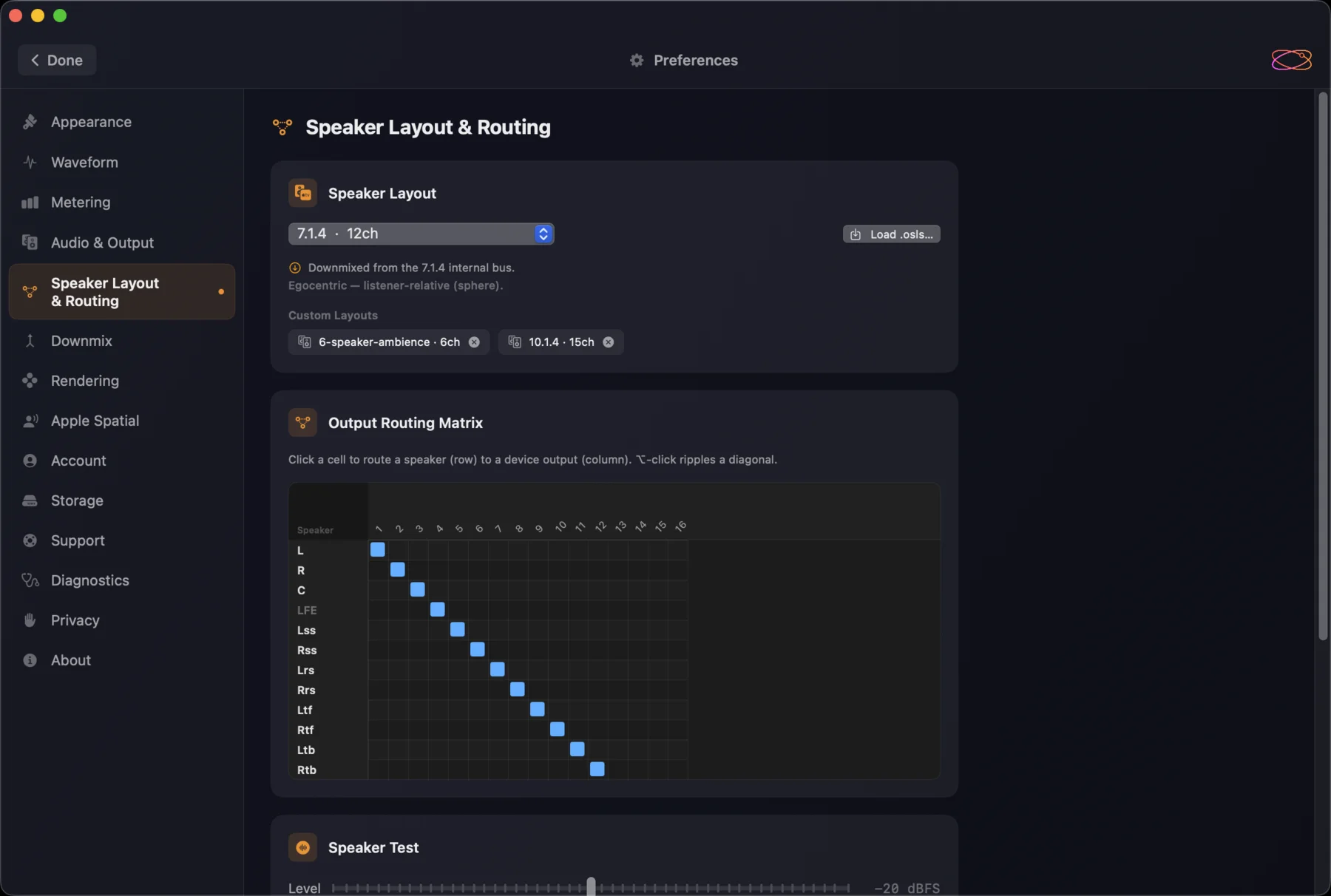
Orbit Lite includes the same routing matrix as the full Orbit app. Click a cell to route a speaker (row) to a device output (column), or ⌥-click to ripple a diagonal. Reset Routing to Straight-Through puts every speaker back on its matching output. See Output Routing for the full matrix controls.
Stereo output
For Binaural and Stereo monitoring, choose which device outputs carry left and right under Preferences ▸ Audio & Output ▸ Stereo / Binaural Output.
7.1.4 output
When using 7.1.4 monitoring, map all 12 channels to your speaker array:
- L / R — Front left and right
- C — Centre
- LFE — Low-frequency effects
- Lss / Rss — Side surrounds
- Lrs / Rrs — Rear surrounds
- Ltf / Rtf — Top front left and right
- Ltb / Rtb — Top back left and right
Orbit Lite will show a conflict indicator if two channels are assigned to the same device output.
Speaker Test
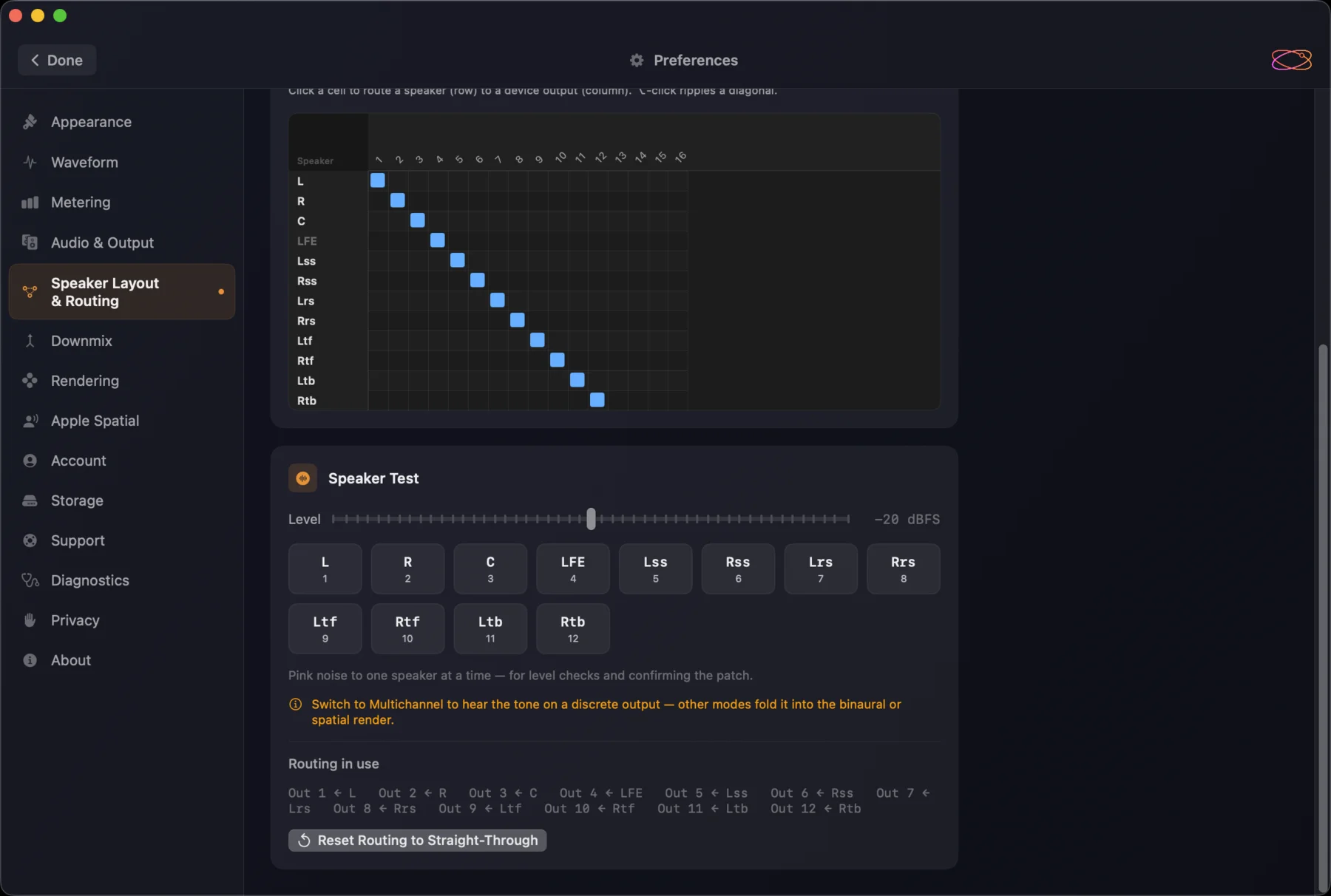
The Speaker Test at the bottom of Speaker Layout & Routing plays pink noise to one speaker at a time, for level checks and confirming the patch. Set the Level, then click a speaker. Stop playback first.
The test tone plays on a discrete output only in speaker monitoring (7.1.4 or a custom layout). In the other modes it's folded into the binaural or spatial render. Below the speakers, Routing in use lists which output each speaker is on.
Speaker layouts
Orbit Lite ships with a set of ready-made layouts:
| Layout | Channels | Layout | Channels | |
|---|---|---|---|---|
| Mono | 1 | 7.1 | 8 | |
| Stereo (2.0) | 2 | 5.1.4 | 10 | |
| Quad (4.0) | 4 | 7.1.2 | 10 | |
| Quad (classic corner square) | 4 | 7.1.4 | 12 | |
| 5.1 | 6 | 7.1.6 | 14 | |
| 3.1.2 | 6 | 9.1.4 | 14 | |
| 5.1.2 | 8 | 9.1.6 (wide) | 16 |
Custom layouts
Beyond the built-in set, Orbit Lite supports custom speaker layouts through OSLS (the Orbit Speaker Layout System) — describe your rig in an .osls file and Orbit Lite will output to it. Custom layouts in Orbit Lite are capped at 24 channels; the full Orbit app supports up to 64.
Sample rate
Preferences ▸ Audio & Output shows the live device sample rate alongside the file's sample rate, so you can spot a mismatch at a glance. When the two differ, a banner also appears at the top of the main window with a one-click Match device to file button — see Sample-rate matching.
Refreshing devices
If you connect a new audio device (like an interface or AirPods), use Refresh Devices to pick it up.